
Confused About What Drives Mortgage Rates?
Understandable if so — because it keeps changing.
It would be great if a single index or report set mortgage rates. But the forces that move them — and which one dominates — shift with conditions. And none of them account for the unexpected.
On Friday, February 27th this year, we urged a savvy client to lock at an excellent rate as geopolitical tensions rose. They wanted to wait for the employment report the following week, which was the indicator driving rates at the time, to see if they could do better. We all know what happened the next day. Within minutes, the conversation shifted from employment numbers to inflation fears. By Monday, rates had jumped, and the 5.99% they could have locked, with no points or fees, turned out to be a deal we may not see again for a while. Since then, rates have tracked inflation as elevated oil costs persist. As of this writing, rates broke 7.125% — the highest since 2023.
In theory, the client wasn’t wrong. Through 2024 and into 2025, the monthly jobs report led: each employment release moved rates, because strong hiring signals an economy the Fed may need to cool, while weak hiring gives it room to cut. As the labor market softened, the Fed lowered its benchmark rate three times in late 2025, and mortgage rates fell alongside it. They were on track to do the same again — until geopolitical tensions erupted.
If your mortgage and car payment are locked in, this may feel beside the point. But among those “protected by low fixed rates,” some experience the “locked-in effect” — unable to give up a low rate to meet a new stage of life — and many have family or friends weighing options right now.
So how do you read a market that keeps changing its mind?
Start with what the headlines don’t make clear: no single report or index sets mortgage rates.
No reliable signal — only the current pressure point
Reports and indices do move markets — but only when they speak to the pressure the economy is focused on at that moment: jobs one year, inflation the next, sometimes consumer confidence, a domestic shock like the pandemic, or one from abroad like Iran. An employment report that moved rates a quarter point last year can pass this year with barely a ripple. No single report is always the one that matters — there is only the one leading now.
Even the proxy can slip
For years, the closest thing to a dependable proxy for mortgage rate movement was the 10-year Treasury yield. Mortgage rates usually track it so tightly that watching the 10-year told you most of what you needed to know. It still often does. Last month, for example, the 10-year broke 5% — its highest since 2007 — the Fed raised the overnight rate a quarter point, and mortgage rates rose alongside it. Those of us who do this for a living have relied on tracking the 10-year Treasury when the bond market opens each morning at 8:00AM to see how lenders’ rate sheets will land mid-morning, usually between 10:30 and 11:30.
But even the 10-year is not absolute. In late 2024 and into 2025 it broke its own pattern — rising while the Fed cut rates and mortgage rates softened. That is an inversion of the norm: the proxy moved one way and the rates it usually tracks moved the other. If the most reliable gauge we have can come loose, no single number is foolproof.
Why the focus keeps shifting
Look at the last six years.
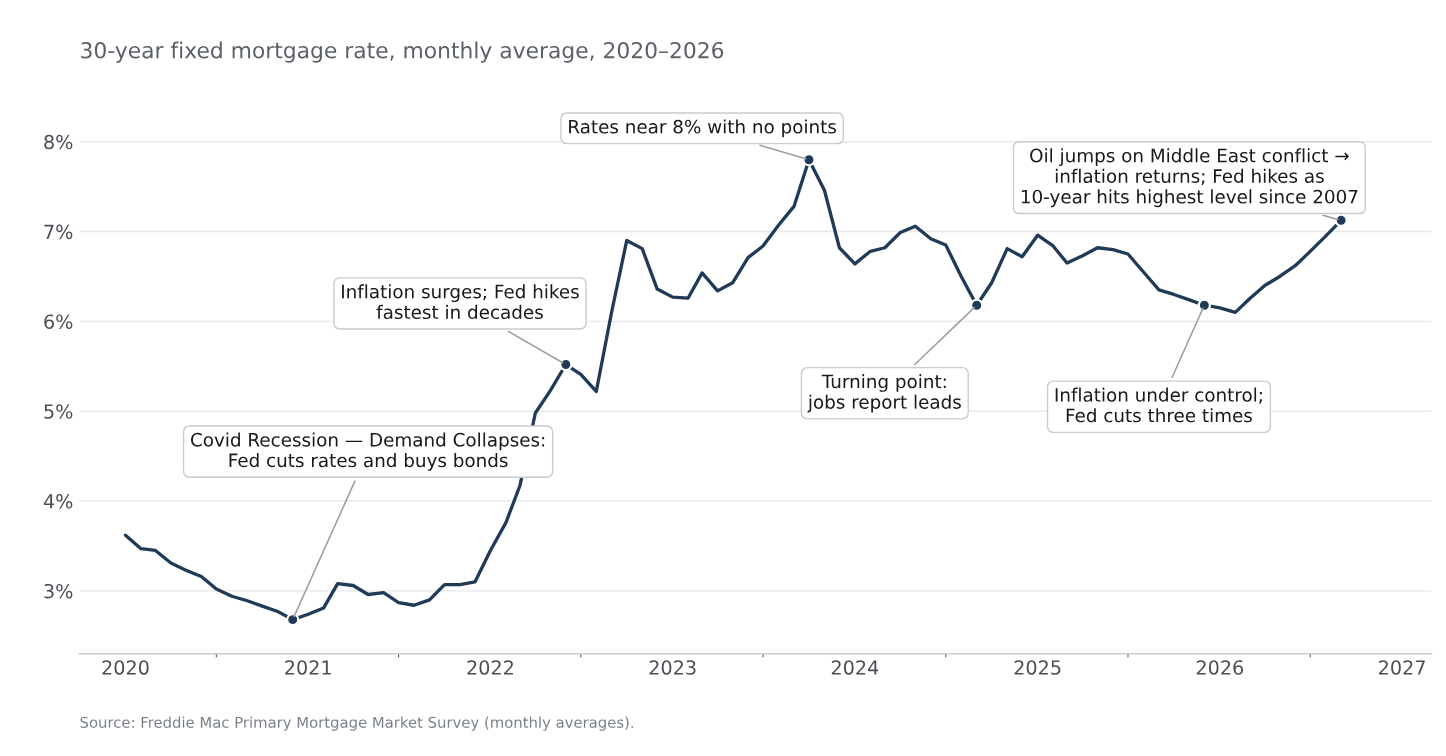
Each turn in the line has a different name on it. In 2020, the Fed cut to near zero and bought bonds to counter a collapse in demand, and rates hit a record-low 2.65%. In 2022, inflation surged, the Fed hiked faster than it had in decades, and rates doubled in a matter of months. Through 2024, the jobs report was the number that moved markets month to month. This year, the conflict abroad pushed oil and inflation back to the front. When inflation runs hot like this, it will override the rest — because rising prices erode the value of money paid back years from now, and that keeps the Fed cautious.
How to read the news without getting whipsawed
Since no indicator holds the lead for long, the subtext to listen for is which pressure the market is focused on now, and hold any single reading loosely. That said, a few carry most of the signal when they’re in focus:
- The 10-year Treasury yield — still the closest daily read on where mortgage rates are heading.
- Inflation reports — a hotter number pushes rates up, a cooler one eases them, and lately inflation is the pressure that matters most.
- The Fed — less the cut or hike itself, which the market prices in ahead of time, than what it signals about sentiment.
- The jobs report — strong hiring points to a hotter economy and higher rates; weak hiring gives the Fed room to ease.
- Oil and events abroad or domestically — they can plummet demand or feed inflation, both of which the Fed was charged with managing through the overnight lending rate.
Whatever you watch, take in the larger balance of risk and reward — stimulating demand or cooling off inflation, and you’ll be on the right track within the known factors. Unfortunately, our client anchored his bets on the jobs report, which had been leading — until it wasn’t.
What’s in a news cycle?
In a word: ratings. Most news isn’t reporting; it’s seeking what’s sensational enough to hold your attention, not what’s useful. That makes it a poor market indicator — but a powerful influencer. When a story hits the news about rates, you’re usually either too late, or the coverage is about to generate the very swing you didn’t want, which is generally a flood of buyers competing for the same houses.
The phone starts ringing when the story runs, without fail. It works because the news is a proxy for authority, which gives consumers confidence — and who doesn’t want confidence they’re doing the right thing before a large purchase or a refinance? But that confidence overrides what would have been better timing, and, multiplied across enough buyers, moves the market on its own.
That’s why reading the market through data matters. Otherwise well-meaning reporters who cover everything from union strikes to the county fair end up shaping whether the average person thinks it’s a good time to buy a home.
The media version is usually oversimplified to create headlines, and for a lot of situations, just plain wrong. The talking point is almost always affordability. But low rates drive up prices — and a higher price can cost you more than a higher rate ever would. Protect yourself and friends from this cycle — run the numbers.
The bottom line
Reports and indexes are more than tea leaves and less than exact science. They show you how the market is performing and where the risk is heading. What they can’t tell you is what comes next — or whether to stay put, move, or refinance.
So rather than trying to predict the turn, decide on what you know: what your next move costs at today’s rate, and how much caution is the right amount — enough to be careful, not so much that it keeps you from moving forward in your life.
This matters whether you’re weighing a move yourself — up-sizing or down-sizing — or helping a family member or friend think through a purchase. Either way, run the numbers in real terms.
Rates pull buyers in and out of the market in waves. According to the National Association of Home Builders, a quarter-point drop in rates can bring roughly 1.4 million more households into the market.
A full percentage-point drop could mean around five million more buyers — competition that drives up prices and makes it hard to land a contract, as we saw in 2020-21.
Source: National Association of Home Builders
Whether rates move from 7% to 6% or 6% to 5%, more buyers mean more competition and, often, more offers over asking.
So what does a point actually cost? On a $400,000 loan, the difference between 6% and 7% is about $263 a month — roughly $15,800 over five years.
That’s real money, but small next to what competition can add over asking in a lower-rate market. Weigh it against what waiting costs: a higher purchase price if values rise while you wait, a bigger crowd of buyers when you do move, and the refinance you can still do later if rates fall. The payment has to work for you as it is. If it does and the home fits your plans, waiting for a better rate is a bet on timing that may not come — the same bet that cost our client a 5.99% lock.
If you’re already locked in
If your low-rate mortgage and car payment are fixed, you may feel exempt from the fray, and rightly so, to an extent. Keep it in perspective, though. A low rate can quietly become a cage — the “locked-in effect,” which keeps you from moving for a job, a growing family, or a home that fits your life better.
The rate was meant to serve the life, not the other way around.
If rates return to the 3s, or anywhere near them — which would take a very different economy than the one we have — you can restructure then: refinance into a shorter term or set an accelerated payoff and save more over the life of the loan.
And if you’re carrying consumer debt, you may not be saving what you think holding the low-rate mortgage. Credit cards now average nearly 25% APR. One family we worked with cut nearly $398,000 in lifetime interest by clearing consumer debt, even while taking a higher mortgage rate to do it. That’s real math, not a shortcut that skips the real cost.
Where you are now — practical next steps
(with an important note at the end if you’re thinking of renting out your current home)
Holding a fixed-rate mortgage
Know your “strike rate” — the rate at which refinancing would actually pay off for you — so you’re optimizing your position for your situation. Our Mortgage Under Management program calculates it, tracks the market, and contacts you when your rate is available, at no cost to clients. Reach us at rmg@rittermortgage.com to set things up.
Carrying consumer debt
Talk to us before you consolidate. Whether it makes sense is highly personal, and the wrong move means overpaying. Get the numbers that apply to you. (See how it worked for the family above.)
Financing a large expense, home or health
Get in touch to compare using home equity against other options, with an eye on long-term debt management.
Feeling the lock-in effect and wanting to upsize or downsize
Get the facts on what waiting actually costs you. You may find you’re holding onto a low rate you don’t need to. It doesn’t hurt to find out.
Important note — thinking of renting out your current home instead of giving up its low rate. Read Tim Spurrier’s article — our guest columnist this issue — on the tax implications of turning a primary residence into a rental. Depending on your long-term plans and income, that low-rate mortgage can end up costing you far more than you’d think.
What drives rates will keep changing — that part is out of anyone’s hands. What’s in yours is how you read it: notice which pressure is leading, hold any single number loosely, and weigh the moment against your own numbers.
Time in the market beats timing the market — and read that way, the decision comes down to your timing and what’s right for you.
If We Can Help
If you’d like to talk through your numbers, we’re glad to.
Email rmg@rittermortgage.com